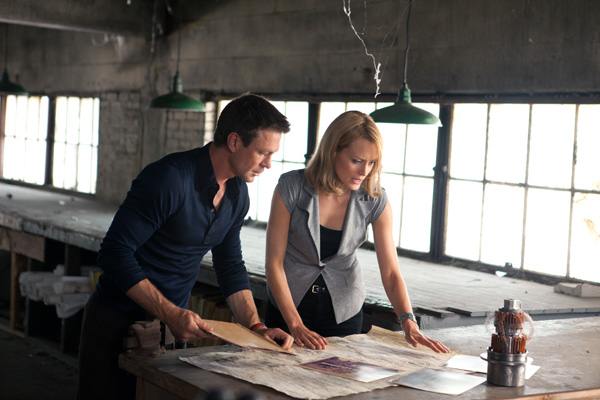
Online searches for Atlas Shrugged , Ayn Rand’s controversial 1957 magnum opus, spiked recently. It wasn’t some coincidental alignment of college lit classes driving the traffic. It was the surprising theatrical release of Atlas Shrugged: Part 1 . The seemingly out-of-nowhere feature debuted in a meager 300 theaters this past weekend, prompting hordes of curious to ask, “Is this what I think it is?” Say what you will about Ayn Rand’s oversized ode to free-market capitalism (and I’m about to), it’s at least epic in its scope. Atlas Shrugged: Part 1 is anything but. According to some sources, the film only got made because poker-playing-CEO-turned-film-producer John Aglialoro was about to lose the rights he had purchased to Rand’s novel. Deadline looming, he cranked out a film version as quickly as possible. (Much like Roger Corman’s piteous, never-released version of The Fantastic Four .) Aglialoro’s solution: Only shoot a third of the story, don’t spend any money on it, and staff it with as many television actors as possible. It’s hardly the treatment devotees of Atlas Shrugged have been waiting 60-odd years for. Rand’s original novel is a hot topic these days thanks to the growth of America’s tea party movement. It’s always been something of a holy writ for hardcore Libertarians. The tea party, with its watered-down interpretation of “gubmint = evil, Wal-Mart = awesome,” is snatching paperback copies off Amazon.com by the thousands. (It’s currently the retailer’s No. 6 best seller!) Whether Michele Bachmann and her anti-intellectual minions have actually read the entire 1,300-page novel or just gone back to staring lustfully at the cover of Sarah Palin’s Going Rogue is open for debate.Perhaps then, Atlas Shrugged: Part 1 represents the perfect opportunity for impatient, borderline illiterate tea partiers (“Impeah Obama!” “Dump the Polititions!”) to digest Rand’s Objectivist teachings without actually having to read one of her books. The film does follow Rand’s original plotline (33 percent of it, anyway) fairly closely. The whole story takes place in the year 2016, when a war in the Middle East has destroyed the oil industry and lead to a massive Renaissance in the railroad industry. … Yup, it’s a futuristic science-fiction movie about choo-choo trains.The problem is, America’s aging railways are a death trap. (Huh, maybe you should have supported Obama’s high-speed national rail system when you had the chance.) Enter Atlas Shrugged ’s heroine Dagny Taggart (played by Taylor Schilling of NBC’s short-lived medical drama “Mercy”). Dagny is a blonde-haired, free-willed Amazonian in a tweed power suit and heir to Taggart Transcontinental Railroad. She can’t stomach her weak-willed brother or the competition-killing policies of America’s nanny state. She wants to carve her own path in business. This involves forming an alliance with Rearden Metal, a small company that has developed a miracle metal half as heavy as steel and twice as strong! Unfortunately, the government tries to talk Dagny out of the new metal business because: a) politicians are a bunch of wussy liberals who aren’t convinced the new metal is safe, and b) it could drive America’s steel manufacturers out of business, and if there’s one thing government hates, it’s a free market economy.For the purposes of this review, let’s simply ignore the facts of Rand’s philosophy: the idea that government only exists to crush the ambitions of noble, enterprising individualists, and the belief that major corporations will always act in the best interest of the public and would never sell us tainted meat or dump oil in the Gulf of Mexico or destroy the city of Bhopal, India. (Pardon me for a second. Bwa-ha-ha-ha-ha ! Sorry. Back to the review.) Let’s take all that as stone-cold fact. Capitalism isn’t just an economic system based on the rewarding of innovation and hard work, it’s a religion in which CEOs are saints and martyrs (like our current Lord and Savior, Donald Trump). Unlike government (boooo!), big business (yaaay!) loves competition and would never attempt to limit the marketplace of ideas by, you know, breaking the law, scamming consumers or driving rival companies out of business. … Bwa-ha-ha-ha-ha ! Sorry, I just can’t get through that with a straight face.Struggling against the arrows of the unholy, anti-capitalist Roman Legions is our beatific beauty Dagny. Politicians (all of whom are portrayed here as cigar-chomping, Martini-swilling fat guys) do their damnedest to stop Dagny’s unchecked superiority. She, meanwhile, exchanges lusty glances with Rearden Metal’s hunky owner Hank Rearden (Grant Bowler, HBO’s “True Blood”). Their idea of foreplay is to discuss, at length, how great radical self-interest (aka “selfishness”) is and how rich people are all geniuses. (You can see the actors practically straining to shout “Greed is good!”)There are hints of the book’s plot-driving “Who is John Galt?” mystery. But mostly there’s endless debate about how safe Rearden Metal’s metal is. You’d think somebody could, I don’t know, test the claims in a laboratory . But no. Eventually, the State Science Institute determines that Rearden’s miracle alloy is the real McCoy. But the eeeeevil government forces the scientists to say otherwise. (Yes, government, science, the media and organized labor are all painted as complicit destroyers of truth, justice and the American way.) Eventually, the only way for our protagonists to prove that Rearden Metal works is to build a suspension bridge out of the stuff and drive a high-speed train over it. ( Really ? That’s the only way?)Clearly, the film’s producers were hoping to hitch this film to the tea party’s wagon. (The charge is even clearer for the film’s releasing company, Rocky Mountain Pictures, which stoked conservative special interest in 2008 by putting out the anti-evolution screed Expelled: No Intelligence Allowed .) But will even the most ardent of small government advocates find a connection to Rand’s nostalgic longing for the era when railroad barons ran roughshod over us ordinary Americans and we liked it ? If so, it will be easy—hell, mandatory —to dismiss criticisms like mine as the desperate ravings of left-wing, socialist media puppets.But in all brutal honesty, I suspect longtime Rand fans will be the most disappointed in this slipshod production. It’s done on a patently shoestring budget. It’s directed like a cheesy Lifetime movie of the week by Paul Johansson, one of the supporting actors on The WB’s “One Tree Hill.” (Yeah, he woulda been my first choice, too.) Occasionally, you might spot someone you recognize. (Hey, isn’t that Quark from “Deep Space Nine” without his makeup?) But the star power is notably weak. The script is cartoonish. The dialogue is wooden. The stone-faced sincerity with which everything is delivered just makes the movie all the funnier. This could be the most unintentionally hilariously cult film (as in “filmed solely for the members of a cult”) since the Scientologists tried to give us Battlefield Earth .
Film Review: Atlas Shrugged: Part 1 Is A Compellingly Awful Adaptation Of Ayn Rand’s Opus
Compellingly Awful Adaptation Argues The Merits Of Capitalism
7 min read