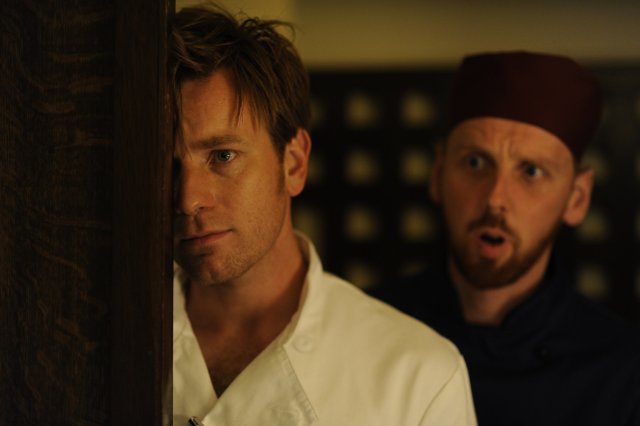
First, humankind loses its sense of smell. The disease comes like a tidal wave, sweeping across the globe but without any known point of origin. Perhaps it’s a pathogen that’s caused this pandemic anosmia, released by terrorists or by a Darwinian mutation. Perhaps it’s a sign of some cosmic expiration date. Whatever the strange phenomenon, the people it’s disabling can’t figure it out, and all the unaffected can do is wait their turns.Losing your sense of smell is one thing. Never breathing in the aroma of another freshly peeled tangerine or the musk of a lover’s skin is a poignant idea. Although stripping people of their ability to sniff their surroundings may make the world less redolent, humans are adaptable. They move on.But next comes taste. It disappears from the world’s collective palate. And then it’s sound. Then sight. One by one, the senses are extinguished, ultimately leaving 7 billion bodies with no way of understanding where they are or what the hell they’re doing.This is the desperately depressing premise of Perfect Sense, from director David Mackenzie ( Young Adam , Mister Foe ). At the foreground of this science experiment are Michael (Ewan McGregor) and Susan (Eva Green). Michael is a chef who can’t commit. Susan is an ornery epidemiologist trying to unravel the great, terrifying mystery. Of course, they fall in love. The trajectory of their romance, which comprises little more than steamy sex scenes and the occasional giggle, is the sole storyline carrying the audience through the apocalypse. Perfect Sense is executed like a film student’s senior thesis. There’s a grand concept, a slapped-together love story, and that’s about it. The film’s biggest flaw is that it rarely ventures beyond exposition. Green serves as the narrator, and the audience experiences each new global catastrophe through nothing more than her explanation dubbed over montage after montage. Every time a new sense is stolen, victims are subjected to violent fits of sorrow, hunger, rage and, ultimately, joy. For example, people weep uncontrollably in the streets, and when they recover, they can no longer smell. Later, they’re overcome with the desire to eat, and they fill their maws with anything in reach—lipstick, jugs of olive oil, flower petals. When the voraciousness has passed, they’re left unable to distinguish salty from sweet. Through each shift, we’re presented with images of people in the midst of these throes and then, like a scrapbook for the senses, glimpses of the textures and experiences they’ll no longer be able to relish. Set to a soundtrack of sad violins (seriously), it’s hard to think of a more heavy-handed or less compelling approach.Meanwhile, Michael and Susan screw like people with nothing left to live for. Aside from a couple of brief, tragic confessions they make to each other, though, we don’t know much about them and aren’t really given any reason to want to know more. McGregor and Green are nice to look at, and we get to see a lot of them, but their characters are presented more like outlines than real people. Perfect Sense does have one fantastic scene in which Michael and Susan shave each other’s chins in a wonderfully gloomy metal bathtub. Lathering each other up, they get a taste (or lack of taste) of shaving cream, and in a burst of whimsy they start nibbling on a bar of soap as though it were white chocolate. Foaming at the mouth and spewing suds with each laugh, they look like children who’ve discovered a new, albeit totally undesirable, power.Still, the film’s script moves in a straight, mostly monotone line. It’s disappointing, since the concept holds so much potential for discovery and emotion. Focusing solely on Michael and Susan uses a limited lens, and it also doesn’t make much sense (pun totally intended). Sure, love is grand, but if every way you know how to connect to the world around you was about to be ripped away, wouldn’t you want to spend time with people other than your new lover or do things other than have sex, as great as it may be? A more interesting way to explore this tragedy might be through the relationships between parents and children, or siblings, or best friends. Any plot choice the filmmakers made, though, would still have been diluted by the fact that there’s no real action here. So much happens in the grand scheme, and yet nothing really happens in the script. Ultimately, Perfect Sense would have a much better chance of being watchable if its filmmakers had followed one of the most basic rules of storytelling: Show, don’t tell.
Film Review: People Lose Their Senses In Frequently Senseless Sci-Fi Drama Perfect Sense
Seems This Sexy, Sci-Fi Drama Forgot Something
5 min read


“Boy

this city stinks like ... wait. No it doesn’t.”
Cold and flu season is upon us.